

INDUSTRIAL NEEDLES · 1851
Industrial sewing-machine needles SCHMETZ
A detailed industrial-only brand guide: point selection, special geometries, coatings and sector recommendations. Household products are deliberately excluded.
SELECTION LOGIC
How to select an industrial needle
- Needle system firstUse only the system specified by the machine manufacturer; similar appearance does not establish compatibility.
- Point for the materialRound points displace textile threads; cutting points control the cut and seam appearance in leather and hard materials.
- Size for thread and pliesMatch the eye to the thread and choose the thinnest stable needle for the material and number of layers.
- Geometry and coatingUse SERV 7, KN, SF or GO for a defined problem; choose NIT or SERV 100 when chrome is insufficient.
- Validate in a sewing trialMaterial finish, thread, machine settings and speed affect the result; verify the complete process before production.
NM size: the metric number corresponds to the blade diameter in hundredths of a millimetre; NM 100 is approximately 1.00 mm. The manufacturer's sector tables are starting recommendations, not substitutes for a sewing trial.
TEXTILES
Round points
The radius determines how the needle displaces woven yarns, knitted loops and elastomeric threads.
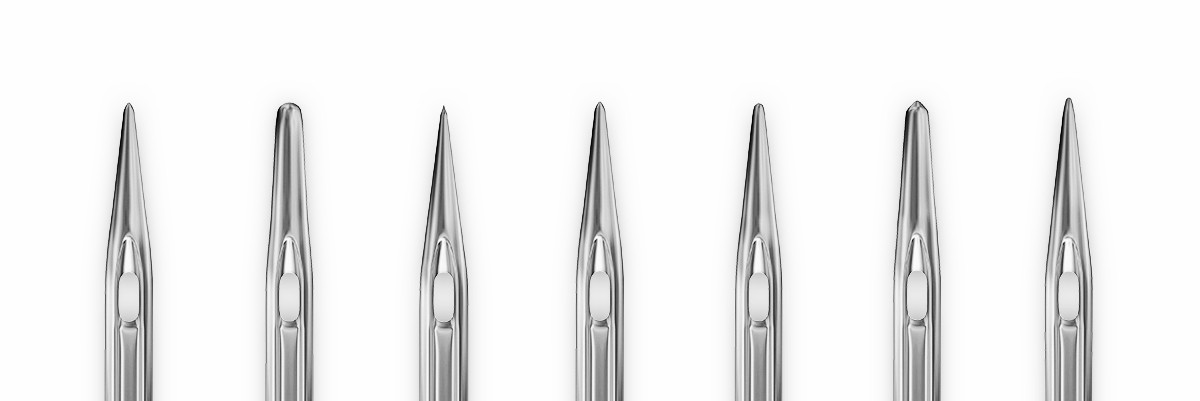
R
Normal round point
Standard acute-conical shape that displaces material threads gently.
- Typical use
- Light fabrics, heavy woven and coated materials, films, soft laminates and leather/textile combinations.
SPI
Acute round point
Slim, precise penetration, a clean seam and reduced seam puckering.
- Typical use
- Microfiber, silk, taffeta, thin coatings, shirt collars and cuffs, fur and pelts.
RRT
Round point with slightly rounded tip
Less prone to burrs, reducing material damage and extending service life.
- Typical use
- Light and medium fabrics, fine and medium denim, technical textiles and leather/textile combinations.
SES
Light ball point
Displaces woven and knitted threads and enters between them without damage.
- Typical use
- Fine and medium knitwear, light denim, jersey, dense light fabrics and textile laminates.
SUK
Medium ball point
A stronger radius reduces penetration force and the risk of damaging loops.
- Typical use
- Medium/heavy denim, coarse knitwear and foundation garments, especially stone- and sand-washed denim.
SKF
Heavy ball point
A strongly rounded point displaces coarse loops locally without piercing yarns.
- Typical use
- Coarse knitwear and fine elastic materials with covered elastomeric threads.
SKL
Special ball point
A very wide rounded point maximizes displacement and passes elastomeric threads safely.
- Typical use
- Medium/coarse elastic materials, Lycra, very coarse knitwear, lingerie and swimwear.
LEATHER · HARD MATERIALS
Cutting points
Cut angle and cross-section determine hole geometry, seam inclination, stitch density and strength.
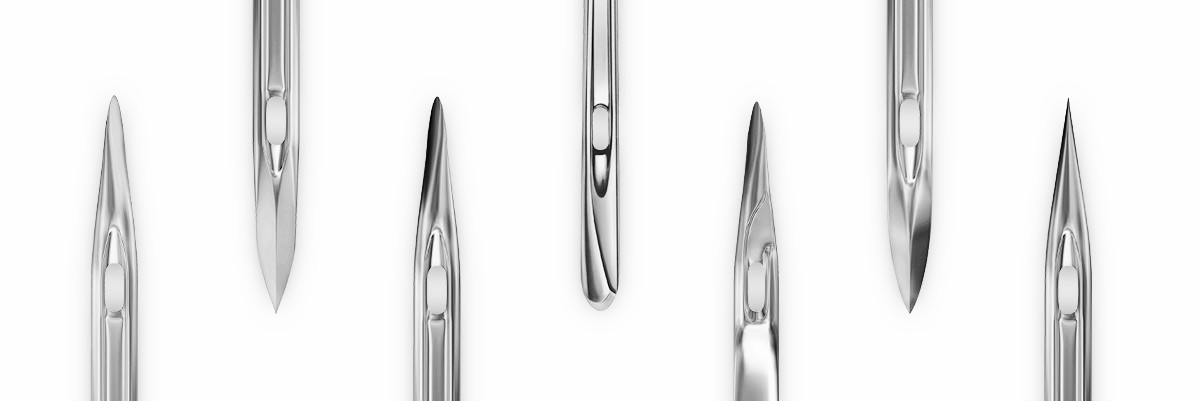
S / N CR
Narrow cross point
Lens-shaped cut along the seam; straight recessed seam with long stitch spacing.
- Typical use
- All leather types; footwear, belts, bags, coarse decorative seams and vehicle seats.
P / NW / PCL / PCR
Narrow wedge points
A transverse lens cut permits up to 8 stitches/cm; PCL/PCR side grooves protect the thread.
- Typical use
- Loaded and decorative seams in footwear, bags, accessories and vehicle seats.
LR / R TW
Reverse twist point
A 45° cut produces a decorative seam inclined slightly to the left.
- Typical use
- Leather clothing, footwear, bags, luggage, belts and vehicle seats.
LBR
Wide reverse twist point
A wide 45° cut exceeds the blade diameter and creates a raised, inclined seam.
- Typical use
- Design-defining coarse decorative seams in garments, luggage and upholstery.
LL / TW / LLCR
Twist point
A 135° cut gives a slightly recessed, nearly straight seam at 5–6 stitches/cm.
- Typical use
- Footwear, shoe repair, bags, luggage and abutting seams on zigzag machines.
DI / DIA
Diamond point
A centered diamond cut along the seam gives precise penetration without deflection.
- Typical use
- Heavy, dry and hard leather; footwear, bags and luggage.
VR / R TW SP
Reverse twist spear point
A diamond-shaped 45° cut, stronger than LR, with a seam inclined slightly left.
- Typical use
- Hard, dry leather, footwear, bags and luggage.
SD1 / TRI TIP
Round point with small triangular tip
Cuts 10–15% of the hole and displaces the rest; straight seam at roughly 6–8 stitches/cm.
- Typical use
- Fine leather, artificial leather, PVC/PUR coatings, films, plastics and multidirectional automats.
DH
Half triangular point
A smaller triangular cut than D; centered penetration and a straight seam.
- Typical use
- Composites, plastic profiles, pressboard, heavy covers, vehicle interiors and upholstery.
D / TRI
Triangular point
Maximum cutting action over nearly the full needle circumference; straight centered seam.
- Typical use
- Very hard dry leather, heavy safety footwear, upholstery, plastics, paper and thick pressboard.
SPECIAL GEOMETRY
Special needle geometries
SERV 7
Higher stability and reliable loop formation
A hump scarf creates a larger loop for reliable hook pickup; 15%, and in some sizes 20%, blade reinforcement reduces deflection. It often permits the next smaller needle size.
- Use when
- Elastic materials, denim cross seams, high plies, automotive interiors and fine sensitive fabrics.
KN
Slim blade against cut loops
A continuously cylindrical slim blade without reinforcement, reduced eye section and slim transition to the ball point.
- Use when
- Very fine knitwear, smaller holes, reduced seam puckering and lower penetration force.
SF
Extra-slim point and eye area
Slimmer than KN from the eye to the ball point, minimizing holes and damage in ultra-fine loops.
- Use when
- Extremely fine 40- and 42-gauge knitted fabrics.
GO
Larger eye for thicker thread
The eye is enlarged by two sizes: NM 70/10 has the eye of NM 90/14; the long groove is wider as well. Lower friction reduces thread damage and breakage.
- Use when
- Thick/effect threads, decorative seams and smaller holes without reducing thread size.
SURFACE ENGINEERING
Coatings
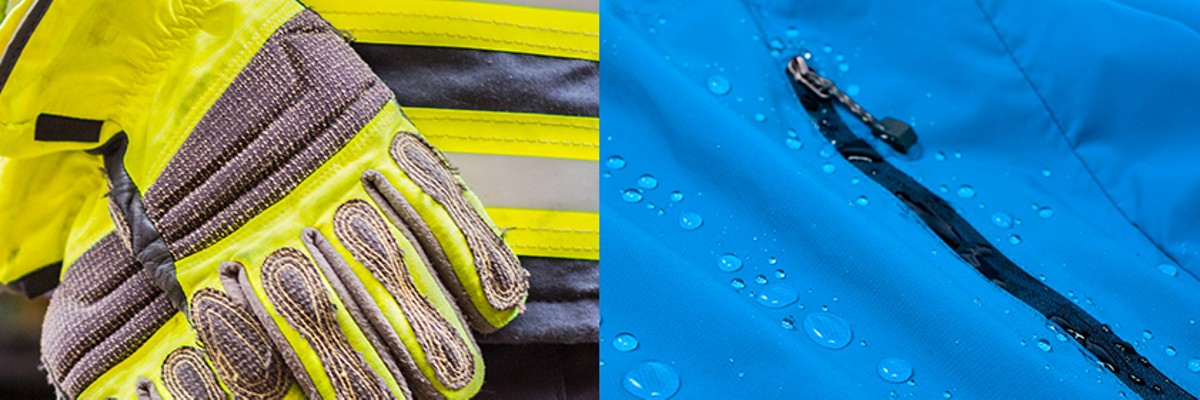
CHROME
Hard chrome — standard
Protects against corrosion and reduces friction. It is normally sufficient for standard industrial processes.
NIT
Anti-adhesive nickel–phosphorus–PTFE
A uniform, smooth, corrosion- and wear-resistant surface; about 20% better thread glide in the eye than chrome. For synthetics, low-melting, coated, heavy and needle-fouling materials.
SERV 100 [TN]
Ultra-hard titanium-nitride coating
TiN over hard chrome is more than twice as hard as standard chrome. It extends point life and reduces breakage and needle consumption on abrasive materials, denim, leather, technical textiles and sports shoes.
SEWING FOCUS
Sector recommendations
Condensed starting ranges from the official SCHMETZ industrial Sewing Focus documents.
| Sector | NM | Point styles | Scope / note |
|---|---|---|---|
| Airbags | NM 70–140 | R, SES | Official SCHMETZ sector recommendation; select size and point for the exact material and layer count. |
| Swimwear | NM 60–90 | SES, SUK, SKF, SKL | Official SCHMETZ sector recommendation; select size and point for the exact material and layer count. |
| Workwear | NM 60–120 | R, SPI, SES, SUK | Official SCHMETZ sector recommendation; select size and point for the exact material and layer count. |
| Ladieswear | NM 50–110 | R, SPI, SES, SUK | Official SCHMETZ sector recommendation; select size and point for the exact material and layer count. |
| Lingerie | NM 60–80 | SES, SUK, SKF, SKL | Official SCHMETZ sector recommendation; select size and point for the exact material and layer count. |
| Luggage and bags | NM 60–280 | R, SPI, SES, SD1, D, DI, VR, LR, LBR, LL, PCL/PCR, S | Official SCHMETZ sector recommendation; select size and point for the exact material and layer count. |
| Safety and cargo belts | NM 110–280 | R, SES | Official SCHMETZ sector recommendation; select size and point for the exact material and layer count. |
| Home textiles | NM 60–120 | R, SPI, SES, SUK | Official SCHMETZ sector recommendation; select size and point for the exact material and layer count. |
| Vehicle interior | NM 100–140 | R, SES, SUK, SD1, LL, LR, PCL/PCR | Official SCHMETZ sector recommendation; select size and point for the exact material and layer count. |
| Denim | NM 70–140 | SES, SUK, SD1, D | Official SCHMETZ sector recommendation; select size and point for the exact material and layer count. |
| Leather wear | NM 65–130 | R, SD1, LR, LBR | Official SCHMETZ sector recommendation; select size and point for the exact material and layer count. |
| Quilting | NM 80–160 | R, SPI, SES, SUK | Official SCHMETZ sector recommendation; select size and point for the exact material and layer count. |
| Umbrellas | NM 60–110 | R, SPI | Official SCHMETZ sector recommendation; select size and point for the exact material and layer count. |
| Tire cord | NM 120–180 | SUK, R | Official SCHMETZ sector recommendation; select size and point for the exact material and layer count. |
| Saddler goods | NM 90–200 | R, SES, SUK, LL, LR, LBR, S, D, DH | Official SCHMETZ sector recommendation; select size and point for the exact material and layer count. |
| Schiffli embroidery | NM 70–170 | NORMAL, STR, SUK | Official SCHMETZ sector recommendation; select size and point for the exact material and layer count. |
| Shoes and footwear | NM 60–200 | R, SES, SD1, S, P/PCL/PCR, LR, LL/LLCR | Official SCHMETZ sector recommendation; select size and point for the exact material and layer count. |
| Protective wear | NM 70–160 | R, SES, SUK, SKF, LR, D | Official SCHMETZ sector recommendation; select size and point for the exact material and layer count. |
| Vehicle seats | NM 80–140 | R, SES, SD1, DH, D, LR | Official SCHMETZ sector recommendation; select size and point for the exact material and layer count. |
| Protective sportswear | NM 70–160 | R, SES, SUK, SKF, SPI, DH, D | Official SCHMETZ sector recommendation; select size and point for the exact material and layer count. |
PDF · DOWNLOADS
Industrial technical documents
Needle-size tables and practical guides to point styles, special geometries, coatings and industrial needle systems.
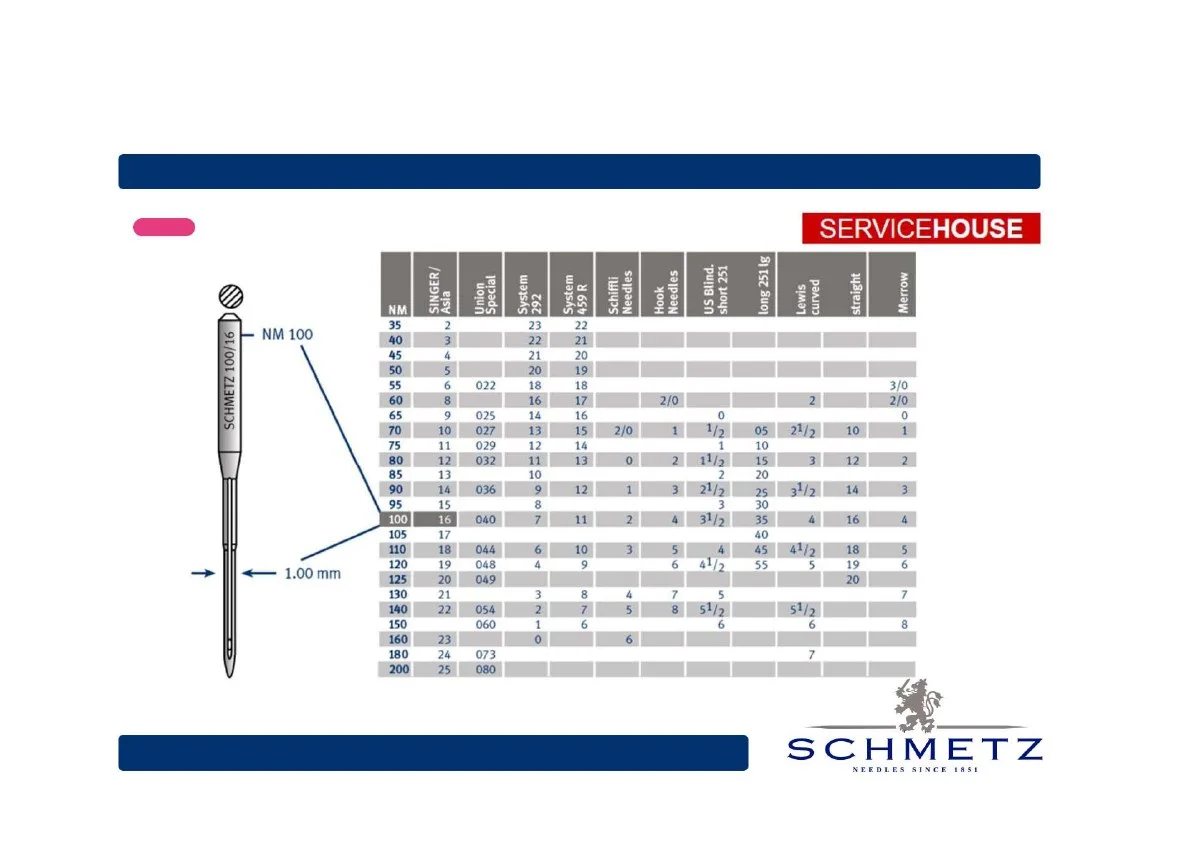
NM / Singer needle-size conversion table
A quick cross-reference between the European NM metric number and the American size designation.
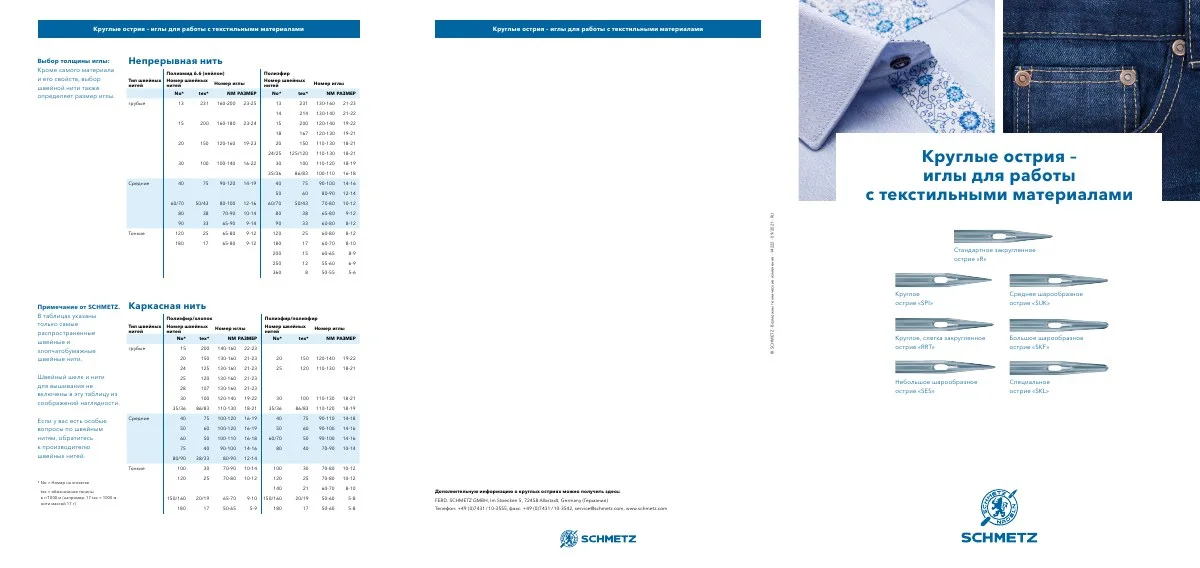
Round points: selection for textile materials
R, SPI, RRT, SES, SUK, SKF and SKL point styles with material, thread and needle-size tables. Russian PDF.
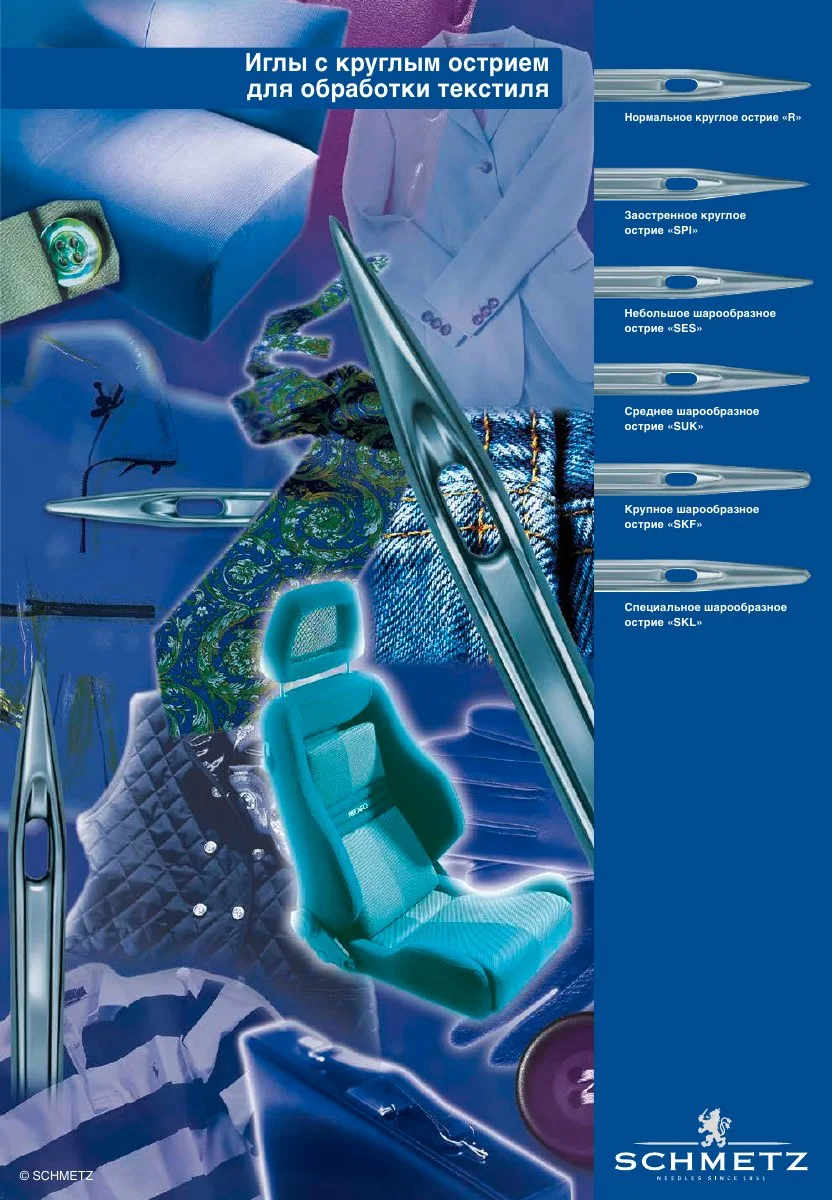
Round-point types for textile processing
A detailed guide to point shape, penetration behaviour and typical industrial materials. Russian PDF.
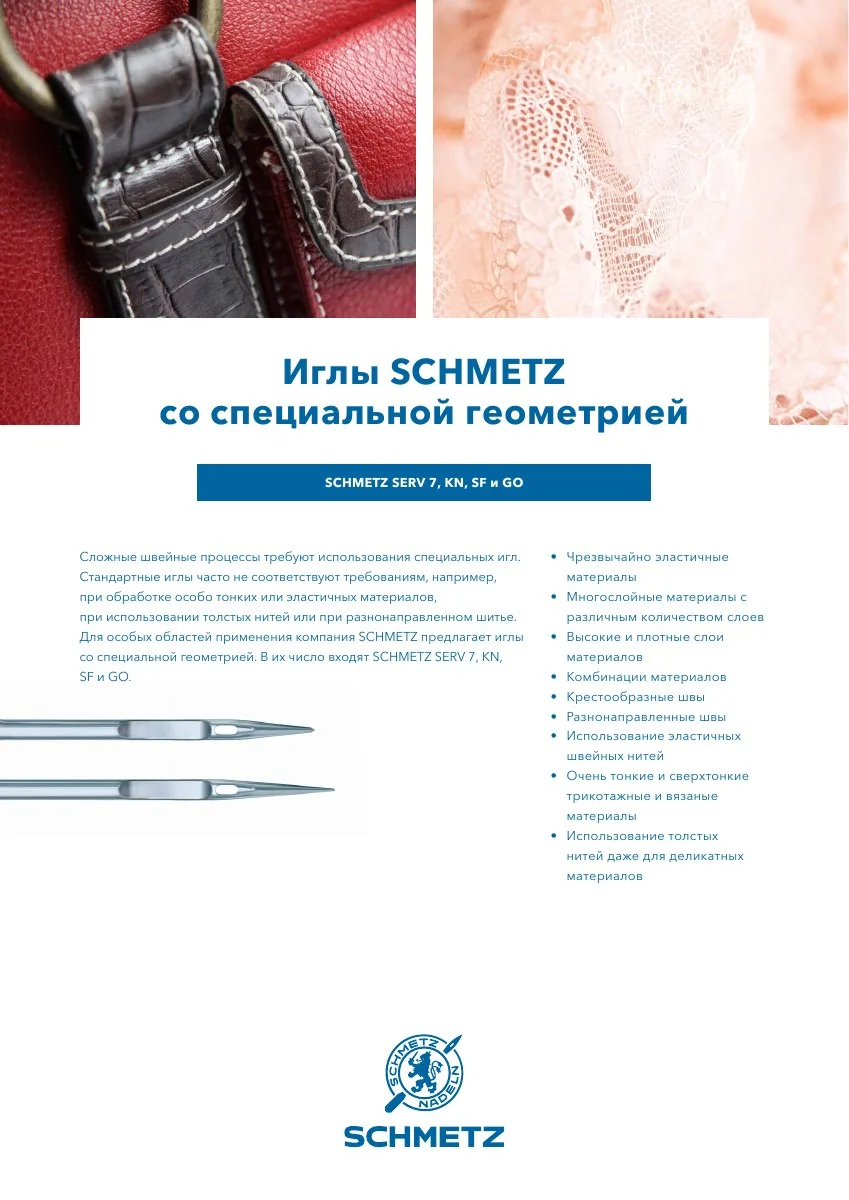
SERV 7, KN, SF and GO special geometries
Solutions for elastic and delicate materials, multi-ply assemblies, thick thread and multidirectional sewing. Russian PDF.
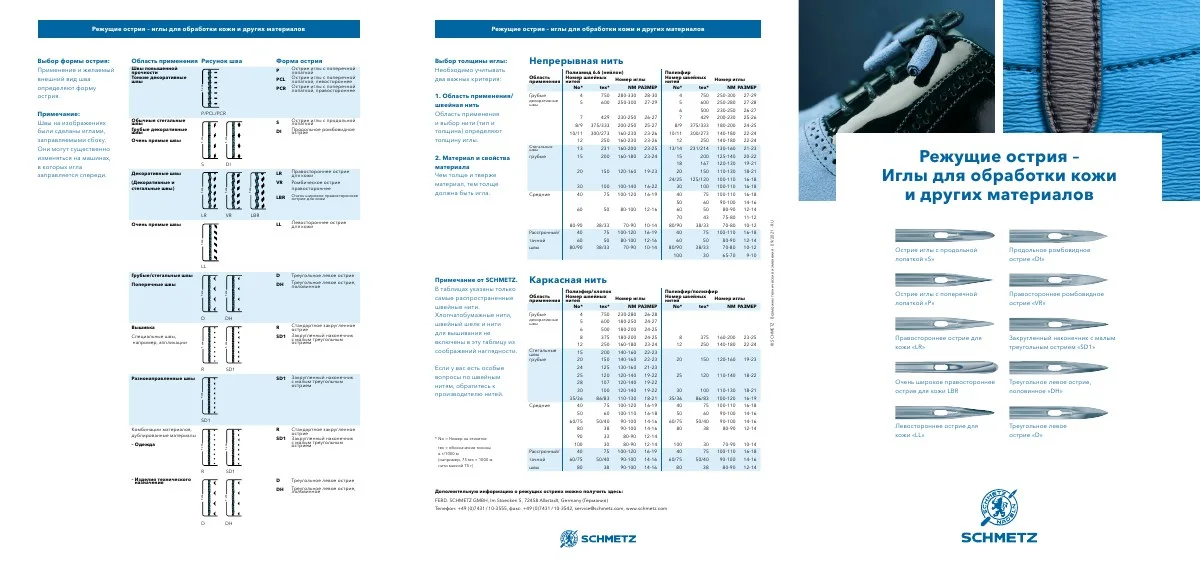
Cutting points for leather and hard materials
Cut direction, seam appearance, permissible stitch density and point-style selection guidance. Russian PDF.
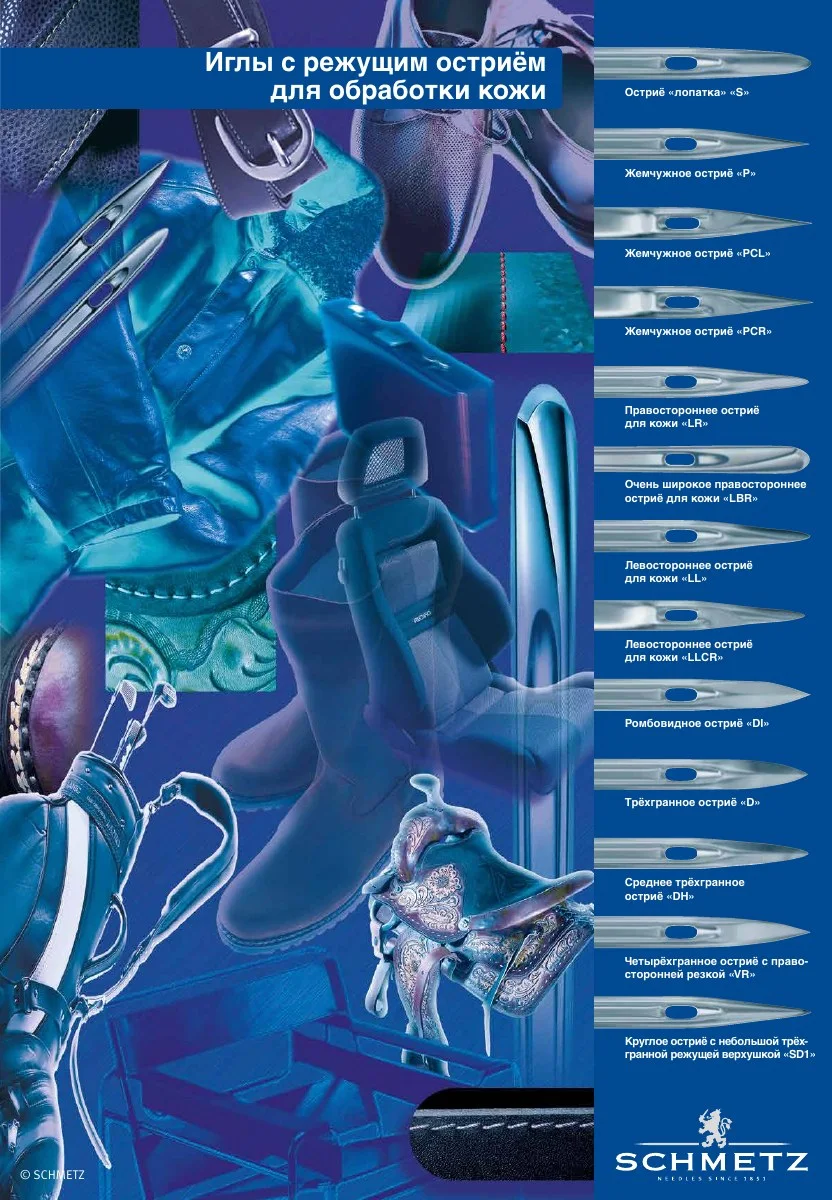
Cutting-point types for leather processing
Comparison of S, P, PCL, PCR, LR, LBR, LL, LLCR, DI, VR, SD1, DH and D with seam illustrations. Russian PDF.
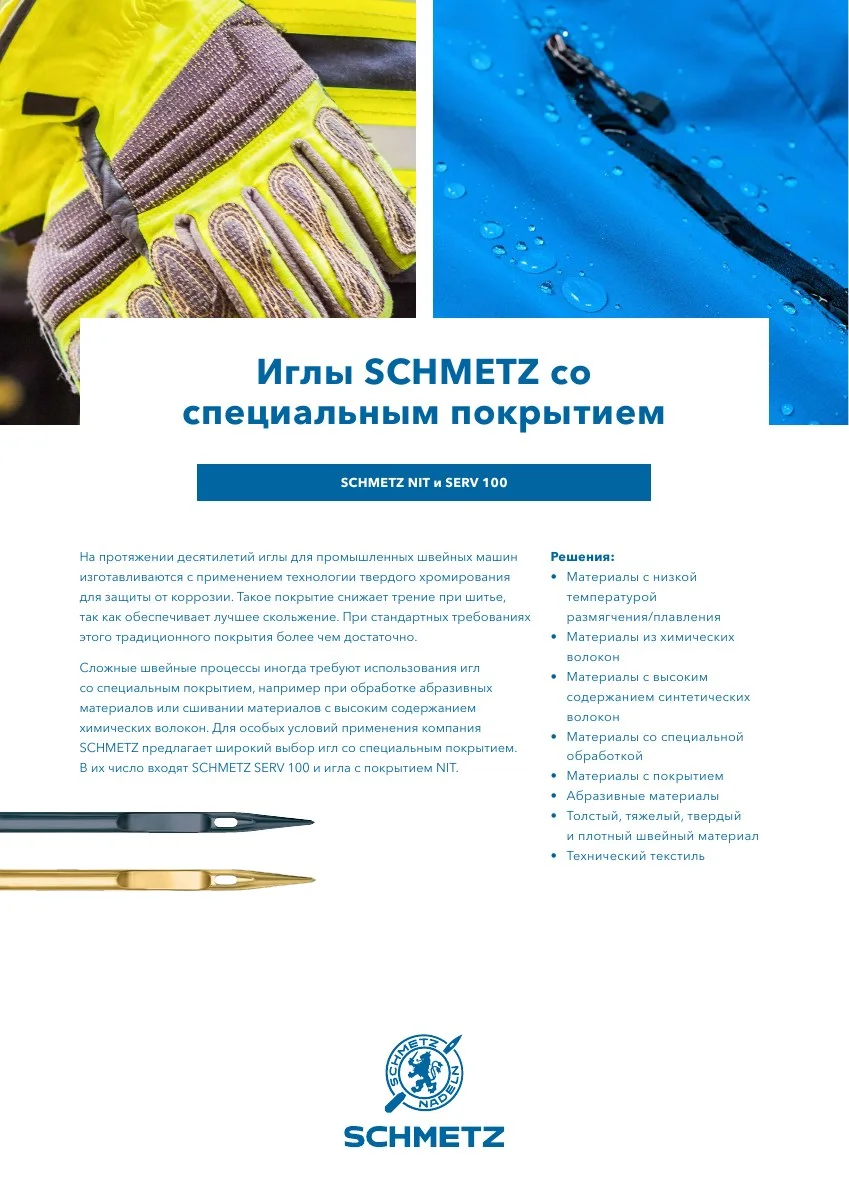
NIT and SERV 100 special coatings
Anti-adhesive and wear-resistant coatings for synthetic, abrasive, coated and low-melting materials. Russian PDF.
Principal industrial needle systems
A 115-page system reference covering designations, equivalent sizes, point forms and frequently used needle systems.
TECHNICAL SERVICE
When a table is not enough
For a reliable recommendation, record the exact machine and needle system, material construction and finish, number of plies, thread, stitch type, speed and the observed defect. SCHMETZ asks for 1–1.5 m² of material for a sewing trial and a sample or detailed photo for problem analysis.